The Energy Regulation Board’s formula now indicates higher Zambia fuel prices for November 2026, a result that is clear enough from the latest market data. Whether the ERB applies the full increase is another question.
Our calculations put petrol at K32.49 a litre, diesel at K35.04 and kerosene at K31.62. All three sit above the 2.5% adjustment trigger. Yet the return of 16% value-added tax on 1 December means the government would be asking consumers to absorb one increase in November and a much larger one weeks later. That makes holding prices broadly firm a reasonable policy choice.
Fields Energy’s first November fuel-price forecast, published on 21 October, placed all three petroleum products below the ERB’s adjustment threshold. The calculation has since changed.
Zambia fuel price prediction for November 2026
When Fields Energy published its first November outlook on 21 October, none of the three products had crossed the ERB threshold. The kwacha has since weakened and international gasoil prices have risen, changing the result.
Using Bank of Zambia exchange-rate data through 27 October and futures prices through 29 October, the calculation now produces:
| Product | Current price | Computed price | Change | Formula status |
|---|---|---|---|---|
| Petrol | K31.46 | K32.49 | +3.3% | Above trigger |
| Diesel | K33.27 | K35.04 | +5.3% | Above trigger |
| Kerosene | K29.76 | K31.62 | +6.2% | Above trigger |
If October’s final kwacha average settles nearer K20.23 to the dollar, the computed prices would be about five ngwee a litre higher.
The kwacha explains much of the revision. It weakened from about K20.14 to K20.45 during the second half of October, lifting the monthly average to roughly K20.21. Applying the ERB’s slate-rate formula to that figure and the corrected September average of K19.67 produces a pricing rate of approximately K20.74.
Oil added further pressure. Gasoil reached a monthly high near $1,520 a tonne on 26 October after attacks on Saudi infrastructure. That increase raised our estimated diesel and kerosene inputs by roughly $2 to $3 a barrel.
| Input | Latest estimate | ERB October build-up |
|---|---|---|
| BoZ selling rate | September: K19.67; October: about K20.21; slate rate: about K20.74 | Slate rate: K20.20 |
| Petrol benchmark | $124.7/bbl | $121.58/bbl |
| Diesel benchmark | $167.9/bbl | $160.88/bbl |
| Kerosene benchmark | $151.0/bbl | $144.00/bbl |
Will the ERB increase fuel prices in November 2026?
A strict application of the formula supports an increase. Our judgment is that the ERB will probably keep November prices broadly unchanged, or apply only a limited adjustment, because December already carries a substantial tax increase.
VAT returns to fuel at 16% on 1 December. If November’s currency and product-price inputs resemble October’s, petrol could reach about K37.70 a litre, diesel K40.65 and kerosene K36.70. That would put December prices roughly 20% above current pump levels.
The government would therefore have to announce two increases in close succession if the November calculation were applied in full. There is little political or practical advantage in doing so. Holding firm in November would give households and businesses one adjustment date around which to plan, while avoiding an increase that would soon be overtaken by the VAT effect.
The complication is that restraint carries a cost. The difference between the calculated price and the pump price would still have to be absorbed, offset elsewhere in the build-up or recovered later. The 5.3% diesel gap and 6.2% kerosene gap are particularly difficult to ignore.
That leaves the ERB with a choice between the formula and the calendar. The formula supports higher prices in November. The calendar favours restraint until December.
Our expectation is that the calendar will prevail, with November pump prices held broadly firm despite the three products clearing the trigger. The larger and more consequential adjustment is likely to come when VAT returns on 1 December.
Zambia fuel price outlook for December 2026
December presents the larger risk for fuel buyers. If the exchange rate and international product prices remain close to October’s levels, the return of VAT could take petrol to about K37.70 a litre, diesel to K40.65 and kerosene to K36.70.
Those estimates are roughly 20% above current pump prices. A November hold would offer temporary relief, though it would leave the underlying pricing pressure unresolved ahead of the December review.
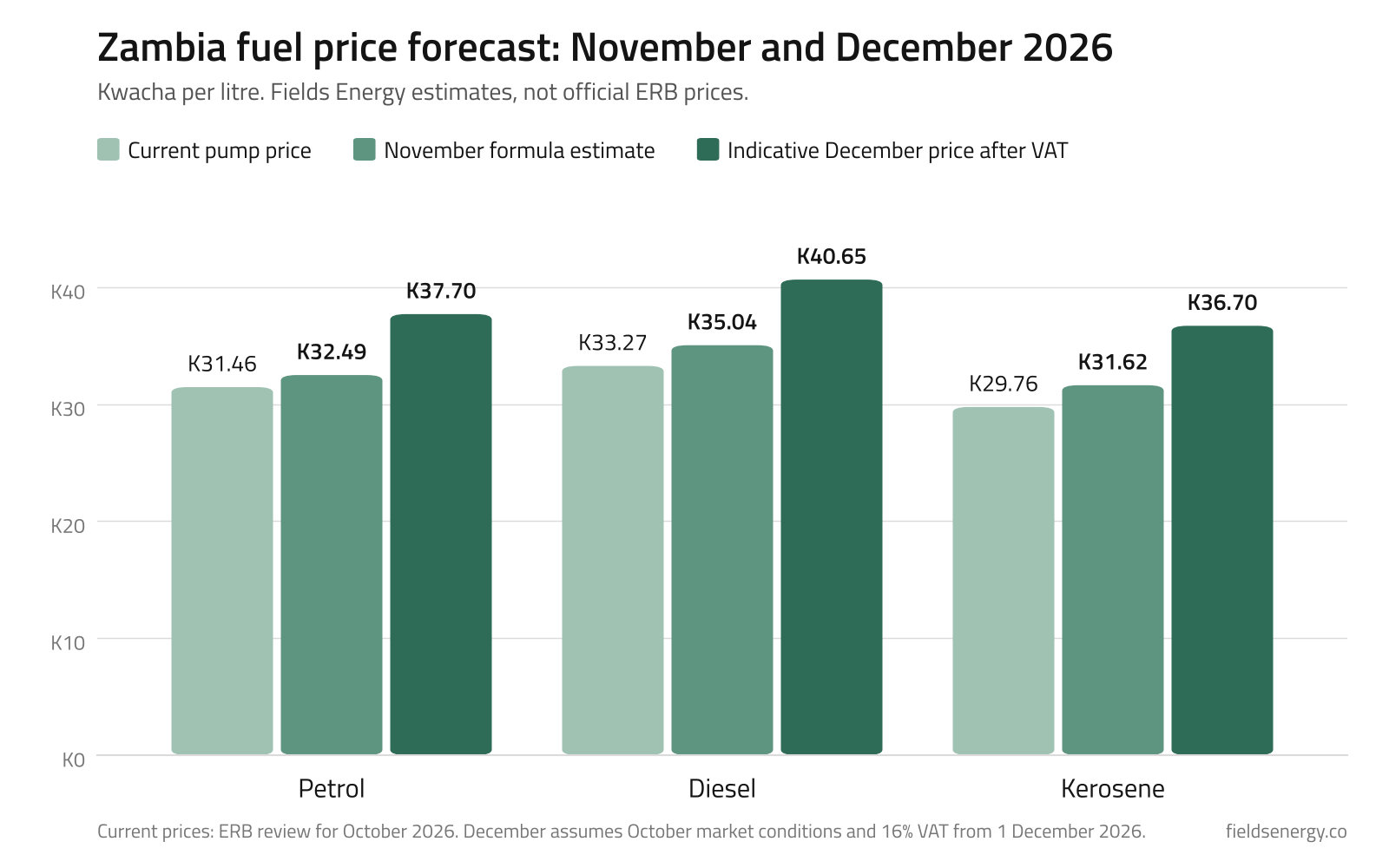
These are Fields Energy estimates, not official ERB prices. The oil inputs use ICE gasoil and NYMEX gasoline futures, adjusted through a spread calibrated against the ERB’s October data. The kerosene parameters were fitted from the October build-up documents. November will be the model’s first independent test, and the final calculation may differ by several ngwee.
Frequently asked questions
Will fuel prices increase in Zambia in November 2026?
The ERB formula indicates an increase across petrol, diesel and kerosene. Fields Energy nevertheless expects November pump prices to remain broadly firm because VAT returns on 1 December and the government may be reluctant to announce two consecutive increases.
What are the predicted fuel prices for November 2026?
The Fields Energy calculation produces K32.49 a litre for petrol, K35.04 for diesel and K31.62 for kerosene. These are formula estimates, not official ERB prices.
Why does Fields Energy expect the ERB to hold fuel prices?
VAT returns to petroleum products at 16% on 1 December 2026. Applying the full formula increase in November would expose consumers to another substantial increase only weeks later, giving the government a reason to keep November prices broadly stable.
What could fuel cost in Zambia in December 2026?
If the exchange rate and international product prices remain close to October’s levels, petrol could reach approximately K37.70 a litre, diesel K40.65 and kerosene K36.70 after VAT.
How does the kwacha affect Zambia’s fuel prices?
The ERB converts dollar-denominated petroleum costs into kwacha using a slate-rate calculation based on Bank of Zambia exchange-rate averages. A weaker kwacha raises the local cost of imported fuel.
Sources
- Bank of Zambia: daily exchange rates
- Energy Regulation Board: October 2026 Pump Price Build-Up
- Energy Regulation Board: Statutory Instrument No. 77 of 2024, the Energy Regulation (Petroleum Products Price Setting) Regulations
- Energy Regulation Board: Review of Petroleum Pump Prices for October 2026, confirming the reinstatement of VAT on 1 December 2026
Buying fuel in bulk?
ERB sets maximum pump prices for retail sales. For bulk supply to your site, ask us for a quote.